
Is a Cruise One of the Easiest Ways to Travel With a Group?
November 11, 2026
By: Amber Robinson
Cruises are one of the easiest ways to travel with a group. Learn when a cruise fits your group what to plan first, an how our team in North Little Rock helps.
Key Points
- Yes, for most groups a cruise is one of the easiest ways to travel together. Everyone unpacks once, meals and entertainment are built in, and you wake up somewhere new without changing hotels. Best of all, people can spend the day doing their own thing and still meet up for dinner. That freedom is what keeps a group happy for a whole week.
- A cruise isn't automatically easy, though. Cabins, dining times, and getting everyone to the port on time all need a plan before anyone books. A cruise works best for groups with mixed interests and energy levels. It's a harder fit for groups that want to spend days in one place or need very specific experiences on land.
Why do cruises work so well for groups?
The biggest reason is simple: a cruise lets your group be together without being together every minute. On a land trip, the group moves as one. Everyone gets on the same bus, eats at the same restaurant, and goes back to the same hotel. That works for a few days, but by day five the early risers are tired of waiting on the night owls, and someone always wants to do something different.
A ship solves that. Here's what it does for a group:
- Everyone unpacks once. No one is rolling suitcases into a new hotel every other night.
- Meals are handled. Dinner can be a group table every night, and breakfast and lunch can be whatever each person wants.
- Entertainment is built in. Shows, music, trivia, pools, and quiet corners are all a short walk from the cabin.
- Each day brings a new place. You can see several ports in one week without anyone planning a single transfer.
- People can split up and come back together. The hikers can take a shore excursion, the shoppers can head into town, and the readers can stay on board.
That last point matters more than people expect. Groups rarely fall apart over the destination. They fall apart over too much togetherness. A cruise gives everyone room to breathe, and that makes the time you do spend together better.
What makes a group cruise harder than it looks?
The ship takes care of a lot. It doesn't take care of the group. These are the places group cruises usually go wrong:
- Cabins get booked one at a time. When everyone books on their own, the group ends up on different decks, with different dining times, and sometimes on different terms. Booking as a group keeps cabins together and keeps everyone on the same timeline.
- Dinner turns into a scramble. Ships have set dining times and flexible dining. If the group wants to eat together, that has to be arranged ahead, not on the first night.
- Arrival is left to chance. The ship won't wait for a delayed flight. Groups that fly in the morning of the cruise are taking a real risk.
- Shore days have no plan. Some people want a booked excursion, others want to wander. Without a plan, the group spends the first hour of every port deciding what to do.
- Documents are an afterthought. Some cruises from U.S. ports can be sailed without a passport, but a passport is strongly recommended. If someone has to fly home early from a foreign port, they'll need one.
- One person ends up doing everything. The group leader becomes the help desk for every question, payment, and change. That's how good friends stop enjoying their own trip.
None of these are reasons to skip the cruise. They're reasons to plan it as a group trip, not a set of separate vacations that happen to be on the same ship.
Is a cruise the right fit for your group?
A cruise is usually a great fit when your group has mixed interests and wants the logistics handled. Use this table to check.
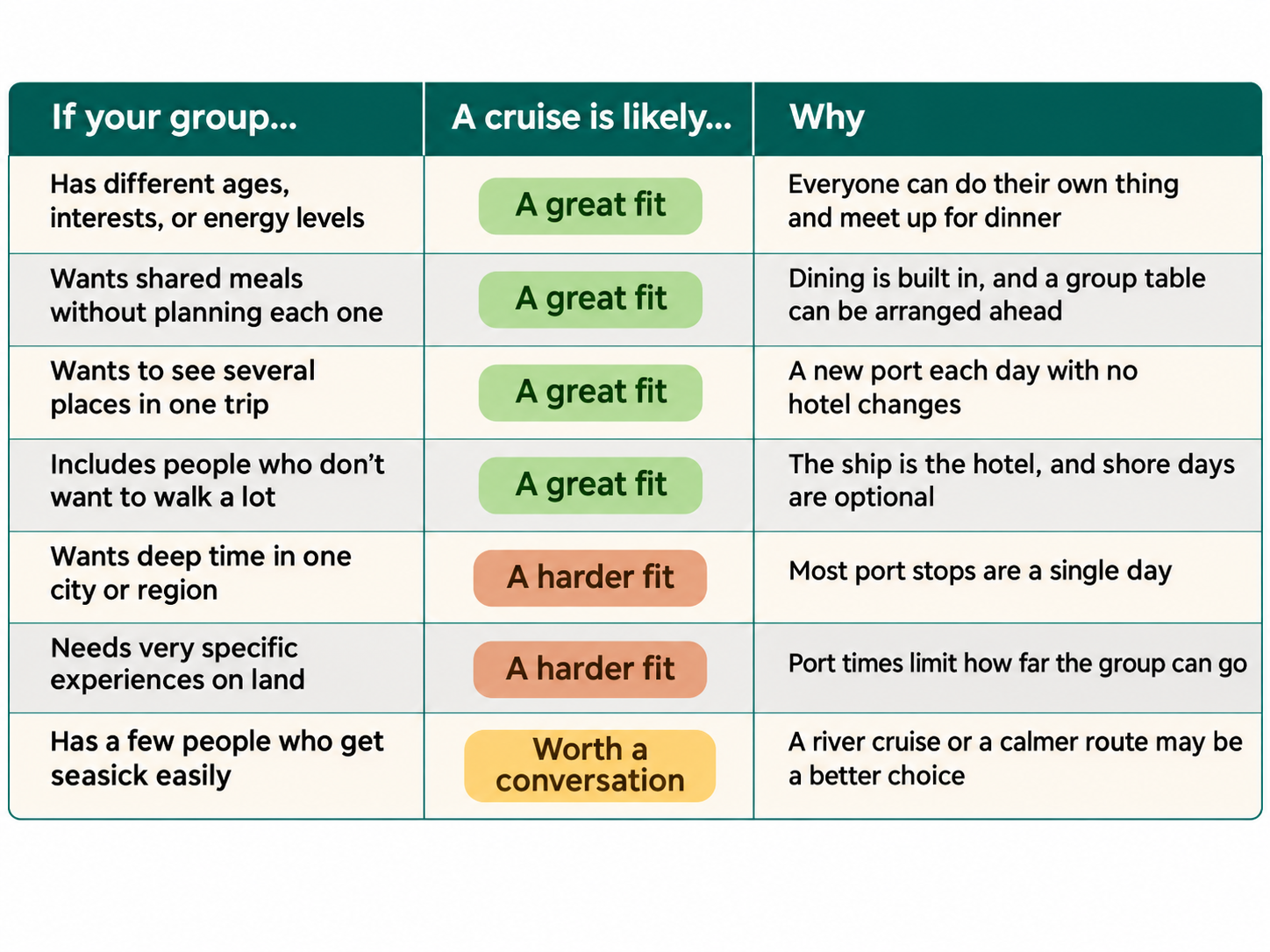
If most of your answers land in the first four rows, a cruise is worth a serious look. If your group lands in the bottom rows, a land tour or a river cruise may serve you better, and that's a conversation our team can help you have.
What kinds of groups do best on a cruise?
Almost any group can cruise well, but some are a natural match:
- Friend groups and girls trips. Everyone gets a real vacation, and no one has to cook or drive.
- Church and ministry groups. Shared meals and quiet space on board leave room for fellowship and reflection.
- Clubs and hobby groups. Pickleball, mahjong, book clubs, and Rotary groups can plan their own meetups on board around the ship's activities.
- Milestone celebrations. A birthday, retirement, or reunion feels like an event when everyone is in one place for a week.
- Alumni and community groups. A cruise gives people who don't see each other often plenty of time to reconnect.
How do you keep a group together without overscheduling?
The best group cruises plan a few anchors and leave the rest open. A good rhythm looks like this:
- A welcome gathering on the first evening, so everyone meets before the week gets busy.
- Dinner together most nights, at a set time and table the group can count on.
- One shared excursion, chosen for the whole group and booked ahead.
- Free time every day, with no guilt for skipping a group activity.
- A farewell gathering on the last night, to close the trip together.
That's enough structure to feel like a group trip, and enough freedom that nobody feels herded.
What should a group leader decide first?
Before anyone books a cabin, settle these five things:
- When and how long. Pick the season and the length of the cruise first. Seven nights is the most common choice for groups, but shorter sailings work well for a first group cruise.
- Which ship and route. The ship matters as much as the ports. A family-friendly mega ship and a small luxury ship are very different weeks.
- How the group will book. Many cruise lines treat a set number of cabins, often around eight, as a group booking. Ask your advisor how group space works on your ship, and hold it early.
- How everyone gets to the port. Flying in the day before is the safest plan. Some groups travel to the port together by motorcoach.
- Who answers questions. Decide up front that payments, changes, and questions go to your travel advisor, not the group leader.
Our Group Leader Starter Guide walks through these decisions in order, with a message you can copy and send to your group.
Ocean, river, or close to home: which cruise fits your group?
"Cruise" covers a lot of ground. Our own 2027 groups show the range:
- An ocean cruise suits groups who want variety and lots to do on board. Carol's February group on Rhapsody of the Seas sails from San Juan to Tortola, St. Maarten, Antigua, St. Kitts, and St. Croix.
- A river cruise suits groups who want culture, smaller ships, and towns you can walk right into. Carol's September group sails Uniworld's SS La Venezia through the Venetian Lagoon, a 126-guest ship built to reach places big ships can't.
- A cruise close to home suits groups who don't want to fly far. William's November group sails the Arkansas River from Tulsa to Little Rock, which means no flight home.
The right choice depends on your group's ages, interests, and travel experience. That's the first conversation we have with every group leader.
Why work with a travel advisor on a group cruise?
You can book a cruise online. Booking a group cruise is a different job. It means holding cabins before people commit, keeping everyone on the same terms, arranging dining, coordinating flights, and answering the same question twenty times. A travel advisor takes that off the group leader's plate. Our group travel team at Sue Smith Vacations plans cruises for church groups, clubs, friend groups, and celebrations. We know which ships work well for groups, how group space is held, and what to plan before anyone sails. And when something changes, your group calls us, not you.
Ready to talk about a cruise for your group?
If your group has talked about sailing together in 2027 or 2028, now is a good time to start. Group space on popular ships goes early.
Kathy Primm is your first call. She'll learn about your group and match you with the right advisor on our team. Call 501-771-0987, or download our Group Leader Starter Guide to get your group's plan started.
Frequently asked questions
- Are cruises good for groups? Yes. Cruises are one of the easiest ways to travel with a group because everyone unpacks once, meals and entertainment are included, and people can split up during the day and meet for dinner. They work best for groups with mixed interests and energy levels.
- How far ahead should a group book a cruise? Most groups should start planning 12 to 18 months ahead. Popular ships and sailing dates fill early, and holding group space before people commit gives everyone time to decide.
- Can a group eat dinner together on a cruise? Yes. A travel advisor can request a set dining time and a group table ahead of the sailing, so the group has a place to meet each night.
- Do you need a passport for a group cruise? It depends on the route. Some cruises that start and end at the same U.S. port can be sailed with a birth certificate and photo ID, but a passport is strongly recommended in case someone has to fly home from a foreign port.
- What's the difference between an ocean cruise and a river cruise for a group? Ocean cruises have larger ships, more activities on board, and more time at sea. River cruises have smaller ships, dock in the center of towns, and focus on culture and sightseeing. Groups who want variety often prefer ocean cruises, and groups who want history and walkable towns often prefer river cruises.