
Planning Group Travel Is Nothing Like Planning a Vacation for Two
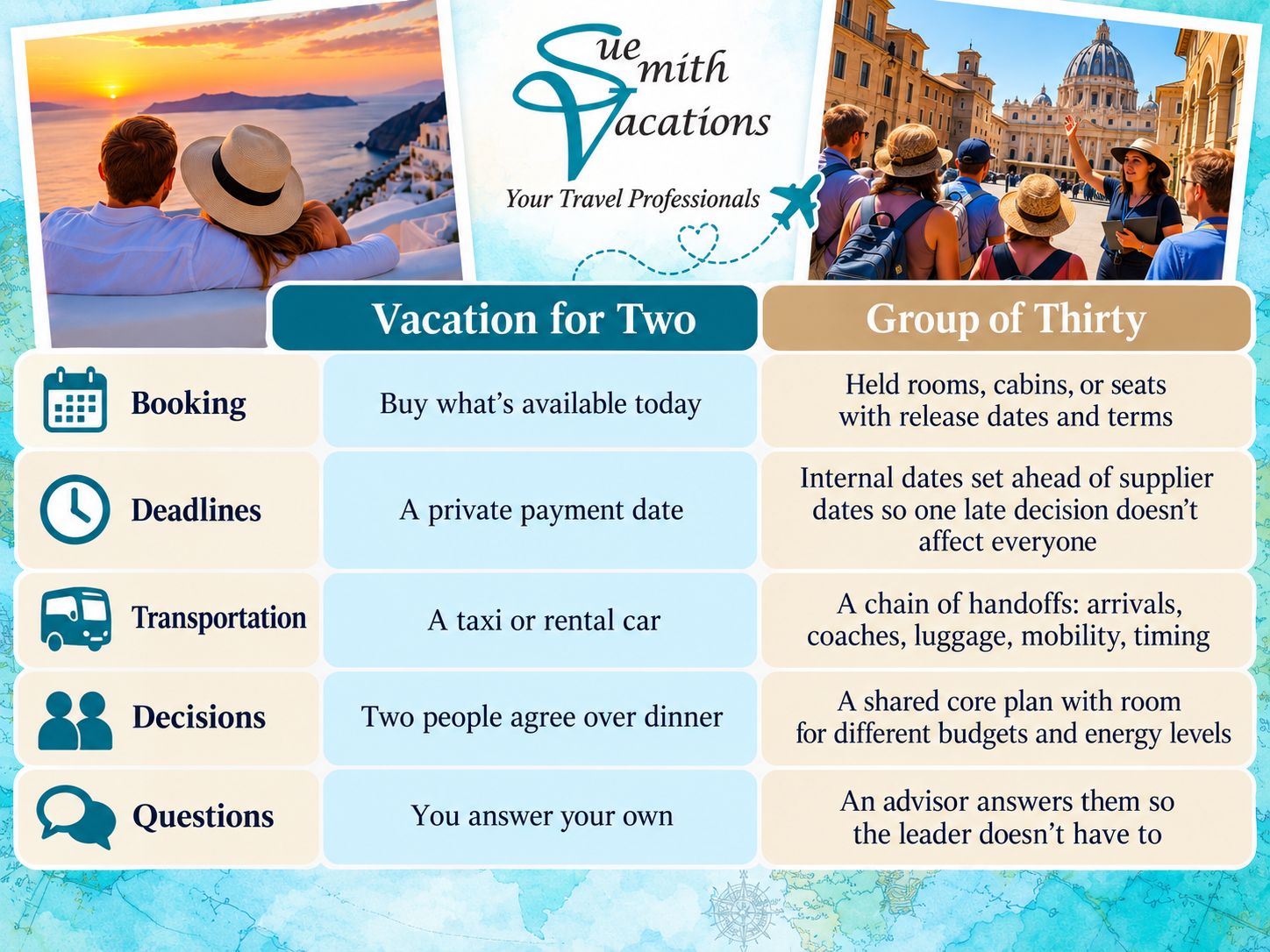
One couple can compare flights over dinner. Thirty travelers may leave from five cities, land hours apart, and expect one motorcoach to be waiting. The trip still has to feel easy, even though the planning isn't.
Summary: Group travel adds contracts, held inventory, deadlines, communication, and human dynamics that never show up in an individual reservation. A good plan has to work for the supplier, the group leader, and the travelers at the same time.
Why should you start with the people, not the place?
A church pilgrimage, a retirement celebration, and a multigenerational family might choose the same country and need completely different trips. The group's purpose is the planning filter. It tells us what belongs, what's optional, and what could pull attention away from the reason people agreed to travel together.
"On one of my pilgrimage groups, several travelers wanted to see so many sites that I had to remind myself our goal wasn't to see how many places we could fit into the itinerary. They'd come to Poland on a pilgrimage, which meant protecting time for the experiences that mattered most and being willing to leave something else out. When I plan a group, I always ask what the trip is supposed to accomplish before I ask how much sightseeing we can fit into a day."
Kathy Primm, Manager, Sue Smith Vacations
What kind of group trip are you planning?
Every group type comes with its own planning questions. Here's where to go next based on yours:
- Church and pilgrimages: sacred sites, daily worship, and pacing that leaves room for reflection.
- Family reunions and multigenerational trips: different ages, energy levels, and mobility needs in one itinerary.
- Celebration trips: retirements, milestone birthdays, and anniversaries where the occasion sets the tone.
- Shared-interest groups: travelers who come together around a hobby, like pickleball trips or a mahjong cruise.
- Group cruises: one booking covers lodging, meals, and transportation between ports, which removes many of the handoffs below.
How do held rooms and cabins change the conversation?
Individual travelers usually buy whatever space is available right now. Groups may work with held rooms, cabins, seats, or supplier programs that come with release dates and conditions. The questions that matter: what's held, until when, under what terms, and what changes if participation rises or falls.
Why do deadlines matter more for groups?
For one traveler, a payment date feels private. For a group, one late decision can affect inventory, transfers, dining, or a shared activity. Strong internal dates come before supplier dates, so the advisor has time to correct names, clarify choices, and protect the group.
Why is group transportation so complicated?
Groups move through airports, arrival halls, vehicles, hotels, and activities. Every handoff has timing, luggage, capacity, mobility, and communication to think through. A beautiful itinerary can fall apart because the vehicle fits the passengers but not their bags, or the coach can't wait for a delayed flight.
"Imagine forty people standing outside customs and immigration in Poland, looking at you, with 65-plus pieces of luggage around them. One of the first things I tackle with a confirmed group is making sure transportation is handled and everyone is comfortable. What most people don't see is me thinking about where that coach can park, how far everyone has to walk with their luggage, whether we have travelers who need extra time, and whether the luggage actually fits underneath the coach." Kathy Primm, Manager, Sue Smith Vacations
How do you keep the group leader from becoming everyone's travel agent?
A capable volunteer can quickly turn into everyone's travel agent. That person should lead the community and the purpose, not privately interpret contracts, chase passport names, and answer every payment question. Clear roles give travelers a direct path to answers and keep the leader from becoming the only bridge.
"I've seen groups begin with a wonderful idea, and suddenly the leader is fielding questions from every direction. When do I make a payment? Do I have to keep my roommate? What documents do we need? Those are questions our Sue Smith Vacations agents handle, not the group leader. My job is to create a process so the leader can lead the group instead of becoming its unpaid travel agent." Kathy Primm, Manager, Sue Smith Vacations
This is where Sue Smith Vacations steps in. We become the point of contact for payments, rooming, documents, and supplier deadlines, so your leader can focus on the people and the purpose. If you're the one organizing, tell us about your group here: Group Inquiry Form
How do different personalities affect group planning?
Groups bring different budgets, energy levels, dining needs, room preferences, and ideas about togetherness. Pretending those differences don't exist just moves the conflict to a more expensive moment. A shared core plan with reasonable freedom usually makes for a happier trip.
When does a group need a professional travel advisor?
A simple domestic weekend for a few experienced friends may be manageable on your own. The case for an advisor grows with traveler count, international travel, shared inventory, payment schedules, transportation handoffs, and traveler needs. If several of those apply, your trip is a coordinated project.
What should you decide before calling a travel advisor?
You don't need a finished itinerary. Bring a purpose, a traveler profile, a realistic size range, an approximate budget range, and a planning window. Separate the non-negotiables from the preferences before forty people start voting on details.
What does good group planning look like?
Travelers may never know how many details were checked. Good planning doesn't look dramatic. It looks like a clear structure, a leader who understands the process, travelers who know what to do next, and enough room to enjoy being together.
What do group leaders ask most?
- Do I need a travel advisor for group travel? If your group is flying, sharing rooms or cabins, paying on a schedule, or includes travelers with different needs, an advisor helps a lot. A short domestic trip for a few experienced friends may not need one.
- What changes when a trip goes from two people to thirty? Contracts, held inventory, deadlines, payment tracking, transfers, and communication all enter the picture. One person's change can affect everyone, so someone has to manage how the pieces connect.
- What should we decide before calling Sue Smith Vacations? The reason for the trip, a rough headcount range, a travel window, and a budget range. You don't need final names or even a destination yet.
- What does Sue Smith Vacations handle for the group leader? Payment schedules, rooming questions, travel documents, supplier deadlines, and transportation. Travelers bring their questions to us, so the leader can focus on leading the group.
- How far in advance should a group start planning? Groups can start planning anywhere from 12 to 18 months in advance for land tours. Group cruises can be planned over 24 months in advance.
- Is there a minimum group size? The smallest group we plan for escorted groups is around 20, while the largest is around 40.
- How does rooming work on a group trip? Rooming is usually decided by the group. If a solo traveler wants to join he/she is always welcome to join a group.
- What happens if someone in the group has to cancel? We recommend everyone in the group get insurance for this exact reason. However, if someone cancels he/she is subject to the cancelations terms of the group.
- Can Sue Smith Vacations plan a parish pilgrimage? Yes. Kathy has led pilgrimage groups to Poland, Italy, Greece, and more! She can plan pilgrimages for a group, parish, or church. Several priest have also worked with Kathy.
What's the next step?
Send us your group's purpose, rough headcount, travel window, and budget range through our Group Travel Form, or call us at 5017710987. Kathy or one of her trusted agents will walk you through planning and booking and be there every step of the way.